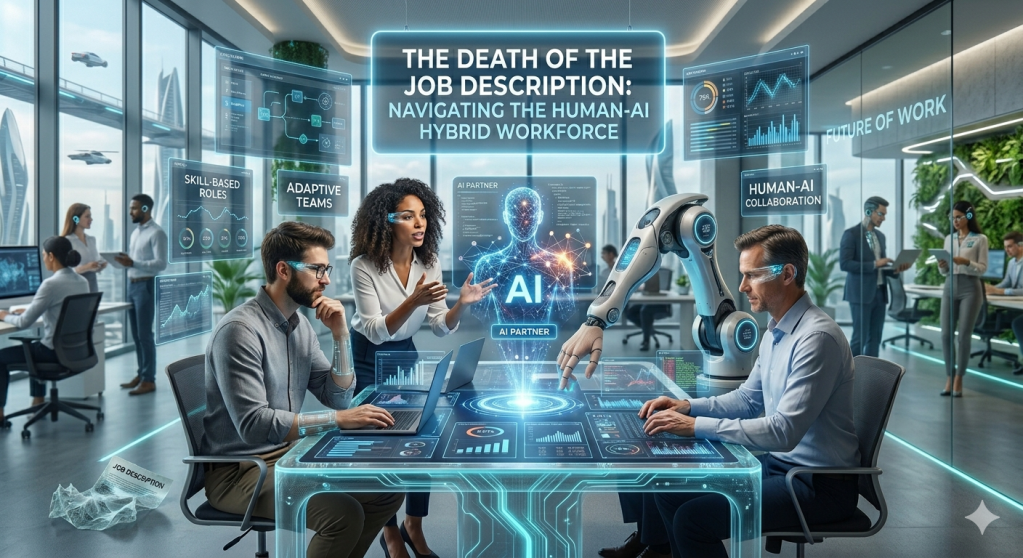
Burgos, June 8, 2026.- The traditional job description, a static relic of the industrial age, has officially met its demise in the face of the 2026 labor economy. For decades, we hired individuals to fill rigid “roles”—Project Manager, Site Engineer, Estimator—assuming that a single human could or should encompass every competency required by that title.
However, as we navigate the complexities of this year, the most successful Managing Directors have abandoned the pursuit of the “all-in-one” employee in favor of Skills-Based Architecture. In an era defined by a persistent global labor shortage and the hyper-acceleration of algorithmic capabilities, we are no longer hiring for roles; we are assembling tasks. This shift requires a fundamental deconstruction of the construction management lifecycle into its constituent atoms of productivity.
By breaking down a traditional project management position, for instance, we find it is composed of distinct technical layers: data-heavy forecasting, logistical scheduling, conflict resolution, and high-stakes negotiation. Under a Skills-Based Architecture, we recognize that assigning an expensive, scarce human resource to the first two tasks is an operational failure.
In 2026, the analytical “heavy lifting”—the predictive scheduling and the quantitative risk assessment—is assigned to AI agents that possess the computational bandwidth to process thousands of variables in real-time. This leaves the human professional to focus exclusively on the “non-computable” tasks: the nuanced stakeholder management, the ethical oversight of on-site safety, and the creative problem-solving that requires physical intuition.
This granular decoupling allows firms to tap into what we now call Fractional Talent. Instead of failing to find one engineer who can do ten things, we utilize specialized human experts for the three things they do best, while the remaining seven are handled by automated systems or niche technical specialists accessed via the global gig economy. For a construction firm, this means our workforce is no longer a collection of full-time equivalents, but a hybrid mesh of human expertise and machine intelligence. This approach solves the labor crisis not by finding more people, but by optimizing the utility of the people we already have.
We are moving toward an assembly-line model of intellectual labor where the Managing Director acts as the chief architect of talent integration, ensuring that every task is paired with the most efficient “intelligence type,” whether biological or silicon-based. To cling to the job description in March 2026 is to invite inefficiency; to embrace task-based orchestration is to finally unlock the true potential of the human-AI hybrid workforce.
Source: AI-generated image Gemini


Leave a Reply